

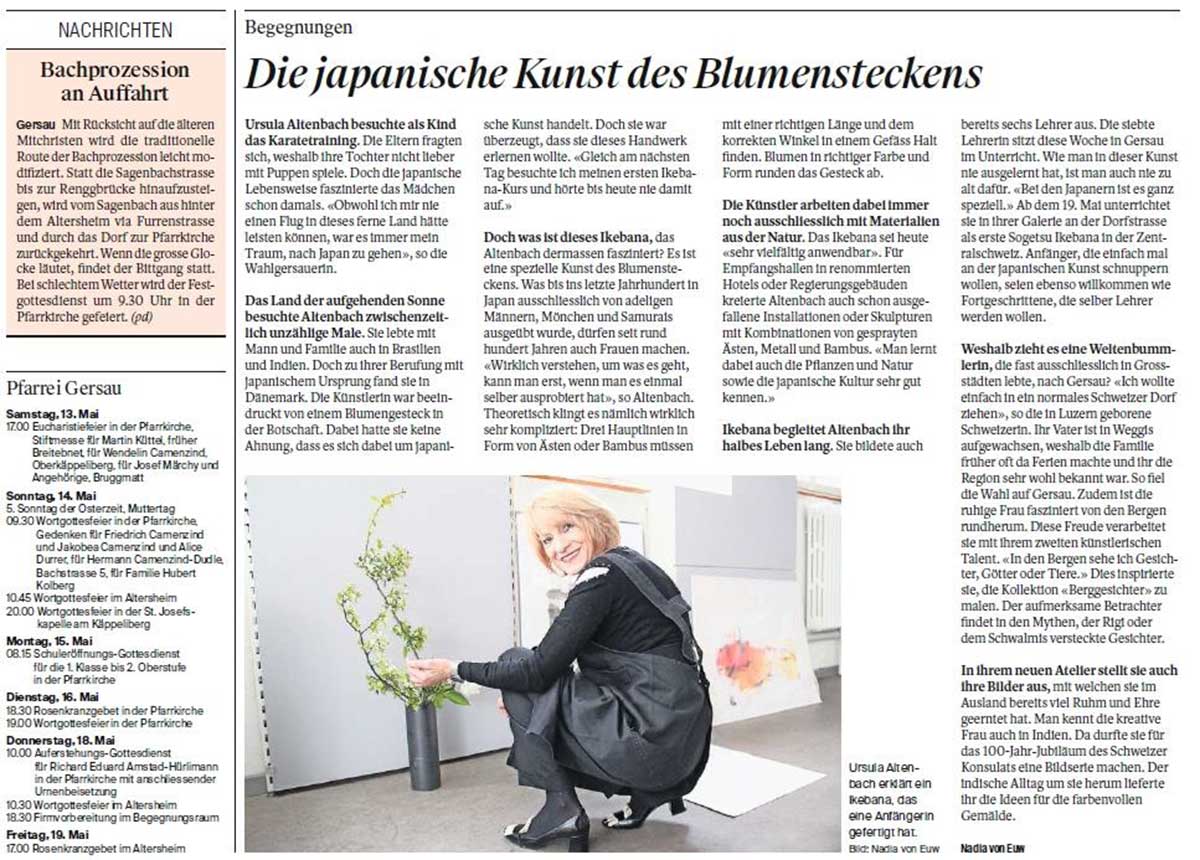
Ursula Altenbach explains an ikebana arrangement made by a beginner. Photo: Nadia von Euw
Ursula Altenbach attended karate training as a child. Her parents wondered why their daughter didn’t prefer to play with dolls. But the Japanese values taught during the lessons fascinated the girl even back then.
“Even though I could never have afforded a flight to that distant country, it was always my dream to go to Japan” says the Gersau resident by choice.
She has since visited the Land of the Rising Sun countless times. Altenbach also lived with her husband and family in Brazil and India. But she found her calling with Japanese roots in Denmark. The artist was impressed by a floral arrangement at the embassy.At the time, she had no idea that it was actually a form of Japanese art. But she was convinced that she wanted to learn this craft.
“The very next day, I attended my first Ikebana class – and I’ve never stopped since” she says.
But what is this Ikebana that fascinates Altenbach so deeply?
It is a special art of flower arranging. What was practiced exclusively by noblemen, monks, and samurais in Japan until the last century has been allowed to be practiced by women as well for about a hundred years.
“You can only truly understand what it’s about once you’ve tried it yourself” says Altenbach.
In theory, it actually sounds quite complicated: three main lines, in the form of branches or bamboo, must be placed in a container at the correct length and precise angles. Flowers in the right color and shape complete the arrangement.
Artists still work exclusively with natural materials. Today, Ikebana is very versatile in its applications. Altenbach has already created elaborate installations and sculptures for reception halls in renowned hotels or government buildings, using combinations of sprayed branches, metal, and bamboo.
“Through this art, you also gain a deep understanding of plants, nature, and Japanese culture” she explains.
Ikebana has accompanied Altenbach for half her life.
She has already trained six teachers. The seventh teacher is attending classes in Gersau this week. Since one never finishes learning in this art, you’re never too old for it. “With the Japanese, it’s something very special” she says.
Starting May 19, she will teach Sogetsu Ikebana at her gallery on Dorfstrasse — the first of its kind in Central Switzerland.
Beginners who simply want to get a taste of the Japanese art form are just as welcome as advanced students who want to become teachers themselves.
Why did a globetrotter who lived almost exclusively in big cities choose to move to Gersau?
“I simply wanted to live in a normal Swiss village” says the Lucerne-born Swiss woman. Her father grew up in Weggis, so the family often spent holidays there in the past, and she was very familiar with the region. That made Gersau an easy choice. In addition, the quiet-natured woman is fascinated by the surrounding mountains. She channels this joy through her second artistic talent: “In the mountains, I see faces, gods, or animals” This inspired her to paint the collection called “Mountain Faces” The observant viewer can discover hidden faces in the Mythen, the Rigi, or Mount Schwalmis.
In her new studio, she also exhibits her paintings, which have already brought her much fame and recognition abroad. The creative woman is also well known in India, where she was invited to create a series of paintings for the 100th anniversary of the Swiss Consulate. Everyday Indian life around her provided the inspiration for her colorful artworks.
Nadia von Euw